
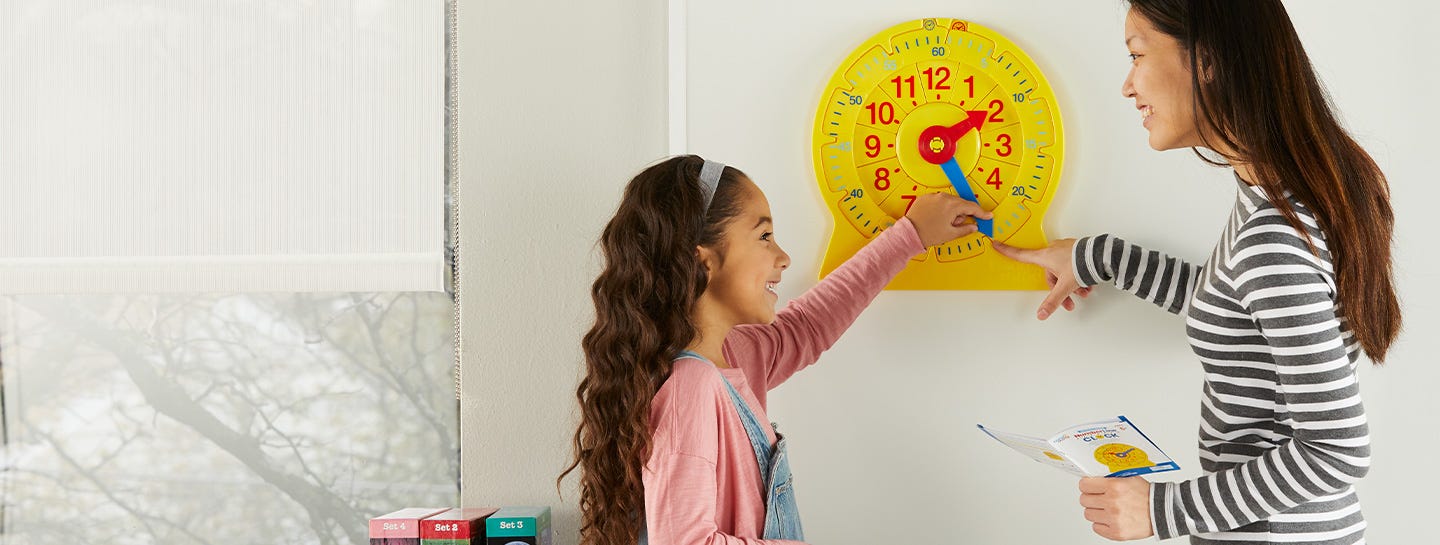
Teaching Children to Tell the Time
Learning to tell the time is an important everyday skill. It helps children understand routines, manage their activities and make sense of how long things take. Because time is abstract, it can take practice to connect the numbers on a clock with the passing of minutes and hours. A gradual, practical approach can make the process easier and more enjoyable.
Start with the idea of time
Before introducing clock faces, talk about familiar parts of the day. Explain what happens in the morning, afternoon and evening, and discuss the order of daily activities: breakfast comes before lunch, for example, and bedtime comes after dinner. Everyday routines help children understand that time moves forward and that events have a sequence.
It is also useful to introduce simple comparisons, such as “shorter than”, “longer than” and “about five minutes”. Children can estimate how long it takes to put on their shoes or walk to the front door, then use a timer to check. These activities build an early sense of duration.
Introduce the parts of an analogue clock
Show children an analogue clock and identify its main features: the numbers from 1 to 12, the shorter hour hand and the longer minute hand. A clock with movable hands can be especially helpful, as children can see how moving one hand changes the time.
Begin with the hour hand. Explain that it points to the number that tells us the hour. At first, practise times when the minute hand points to 12, such as one o’clock or six o’clock. These “o’clock” times provide a clear starting point.
Build understanding of minutes
Once children recognise o’clock times, introduce the minute hand. Explain that each number on the clock represents five minutes when counting around the face: 1 is five minutes past, 2 is ten minutes past, and so on. Counting in fives while pointing to each number can help make this pattern familiar.
Next, practise common phrases such as “quarter past”, “half past” and “quarter to”. Make clear that “quarter past” means 15 minutes after the hour, while “quarter to” means 15 minutes before the next hour. Using a clock with movable hands lets children see why the hour hand moves gradually between numbers rather than jumping from one to the next.
Connect analogue and digital time
Digital clocks show time using numbers, while analogue clocks show it with hands. Children benefit from seeing both formats together. For example, place a digital time such as 3:30 beside an analogue clock set to half past three. Ask the child to match the two, then swap the examples around.
It can help to explain that the two digits after the colon show the minutes. Practise reading digital times alongside familiar daily events, such as the time school starts or a favourite programme begins. This gives the numbers a practical meaning.
Make practice active and enjoyable
Short, regular activities are often more effective than long lessons. Try some of these ideas:
- Make a paper clock: Add movable hands with a split pin and ask children to show different times.
- Match the cards: Pair cards showing written, digital and analogue versions of the same time.
- Use a daily timetable: Ask children to find when activities begin and work out what comes next.
- Play “What time is it?”: Set a clock and invite children to read it, or call out a time for them to show.
- Estimate and check: Guess how long a simple task will take, then use a timer to compare the estimate with the result.
Allow for common challenges
Some children find it difficult to remember which hand shows hours and which shows minutes. Consistent colours or labels can help at first. Others may read the numbers correctly but struggle to understand that the hour hand moves gradually, or that “quarter to” refers to the next hour. Demonstrating these ideas with movable hands and real examples can make them clearer.
There is no need to rush. Revisit earlier skills, celebrate progress and offer gentle corrections. Children learn at different rates, and confidence grows through repeated practice.
Make time part of everyday life
The best practice often happens during ordinary routines. Ask what time it is before leaving the house, how long remains until lunch, or when an activity will finish. These small conversations show that telling the time is useful beyond the classroom.
By moving from daily routines to clock faces, and then connecting analogue and digital displays, children can develop a stronger understanding of time. With patience, practical examples and plenty of opportunities to practise, reading a clock can become a skill they use with confidence.
Enhancing Life Skills: The Benefits of Teaching Time to Children
- Builds everyday independence.
- Strengthens number skills.
- Encourages punctuality.
- Supports daily routines.
- Develops an understanding of duration.
- Boosts confidence with clocks.
Challenges in Teaching Time: Overcoming Abstract Concepts and Clock Confusion
- It can be difficult for children to grasp abstract ideas such as minutes and hours.
- Learning analogue and digital clocks takes regular practice.
- Confusing the hour and minute hands can slow progress.
Builds everyday independence.
Teaching children to tell the time helps build everyday independence. When they can read a clock, they are better able to follow routines, get ready on time and understand when activities will begin or end. This gives them more confidence to manage small responsibilities for themselves, from knowing when to leave for school to keeping track of time during play.
Strengthens number skills.
Teaching children to tell the time strengthens number skills by giving them regular practice with counting, sequencing and recognising patterns. Reading an analogue clock encourages them to count in fives, work with numbers up to 60 and understand how hours and minutes relate to one another. These practical activities also support addition and subtraction, helping children apply number skills to everyday situations.
Encourages punctuality.
Teaching children to tell the time encourages punctuality by helping them understand when activities begin and how long they have to get ready. As they learn to follow a timetable, arrive on time and plan ahead, they develop habits that support independence and reliability at school and in everyday life.
Supports daily routines.
Teaching children to tell the time helps them understand and follow daily routines. When they can read a clock, they know when it is time to get ready for school, have a meal or go to bed. This makes the day more predictable, encourages independence and helps children manage transitions between activities.
Develops an understanding of duration.
Teaching children to tell the time helps them understand duration: how long an activity lasts and how one period compares with another. By estimating and measuring the time needed for everyday tasks, such as getting dressed or walking to school, children begin to connect minutes and hours with real experiences. This awareness can help them plan activities, manage routines and develop a stronger sense of how time passes.
Boosts confidence with clocks.
Teaching children to tell the time helps build their confidence with clocks. As they learn to recognise the hands, read different times and connect clock faces with their daily routines, clocks become less confusing and more familiar. Regular practice and small successes encourage children to trust their skills and feel more independent when managing their day.
It can be difficult for children to grasp abstract ideas such as minutes and hours.
One challenge of teaching children to tell the time is that minutes and hours are abstract ideas. Unlike objects they can see or touch, these units describe how long something lasts, which can be difficult for children to picture and compare. A child may learn to read the numbers on a clock without fully understanding what five minutes or an hour feels like. Using familiar routines, timers and practical activities can help make these concepts more concrete, but they often require patience and repeated practice.
Learning analogue and digital clocks takes regular practice.
Learning to read both analogue and digital clocks takes regular practice, which can be challenging for children and teachers alike. Children must remember how clock hands relate to hours and minutes while also understanding the different way digital clocks display time. Without frequent opportunities to practise, they may forget these skills or confuse the two formats, so short, repeated activities are often needed to build confidence.
Confusing the hour and minute hands can slow progress.
Confusing the hour and minute hands can slow a child’s progress when learning to tell the time. If they mix up the shorter hour hand and the longer minute hand, they may misread the clock or struggle to understand how the hands work together. Clear explanations, consistent reminders and regular practice with a clock that has movable hands can help children distinguish between them and build confidence.