
Speaking Skills in Communication
Speaking is one of the most important ways we share information, express ideas and build relationships. Strong speaking skills can help us communicate clearly at work, in education and in everyday life. They are not simply about choosing the right words: tone, pace, listening and awareness of the audience all play a part.
What are speaking skills?
Speaking skills are the abilities we use to communicate effectively aloud. They include organising our thoughts, explaining ideas, adapting our language to different situations and responding to other people. Good speakers aim to make their message easy to understand while helping listeners feel included and respected.
Key elements of effective speaking
Clarity and structure
A clear message is easier to follow. Before speaking, consider the main point you want to make and arrange supporting details in a sensible order. In a presentation, for example, an introduction, a few key points and a brief conclusion can help the audience keep track of your message.
Tone, pace and volume
The way something is said can influence how it is understood. Speaking at a steady pace gives listeners time to process information, while appropriate volume makes it easier for them to hear. Varying your tone can also add emphasis and help keep an audience engaged. Pausing is useful too: it can give an important point room to register and allow you to gather your thoughts.
Choosing words for your audience
Effective speakers consider who is listening. You may use technical language with colleagues who know the subject, but explain unfamiliar terms when speaking to a wider audience. Simple, precise language is often more effective than complicated wording.
Non-verbal communication
Facial expression, posture, gestures and eye contact can support the spoken message. Open body language may help create a welcoming atmosphere, while looking towards listeners can show engagement. These cues should feel natural and appropriate to the setting, and it is important to remember that people communicate non-verbally in different ways.
Speaking and listening go together
Good communication is not a one-way process. Listening carefully helps you understand what another person means and respond relevantly. Give people time to finish, avoid interrupting and ask questions when something is unclear. Reflecting back a key point in your own words can also help check that you have understood correctly.
How to improve your speaking skills
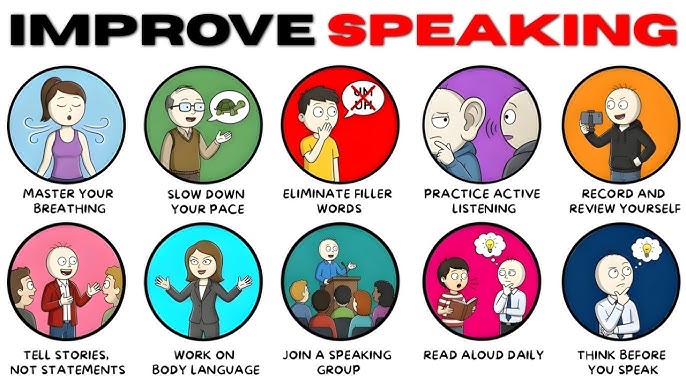
- Practise regularly: Take opportunities to contribute in meetings, join discussions or explain a topic to someone else.
- Prepare key points: A short plan can help you stay focused without making your delivery sound overly rehearsed.
- Record yourself: Listening back can reveal whether your pace, volume and explanations are easy to follow.
- Ask for feedback: A trusted listener may notice strengths and areas for improvement that you have missed.
- Manage nerves: Slow breathing, preparation and a brief pause before speaking can help you feel more settled.
- Learn from others: Notice how effective speakers organise ideas, explain unfamiliar topics and respond to questions.
Speaking with confidence
Confidence does not mean never feeling nervous. It means being prepared, focusing on the message and continuing even when you feel some uncertainty. If you lose your place, pause, take a breath and return to your main point. Most listeners are more interested in understanding what you have to say than in judging every small mistake.
Conclusion
Strong speaking skills help people share ideas, build trust and work through differences. By speaking clearly, adapting to your audience and listening with care, you can make everyday conversations and formal presentations more effective. Like any skill, communication improves with practice, attention and a willingness to learn.
Enhancing Communication: 9 Benefits of Effective Speaking Skills
- Helps express ideas clearly.
- Builds confidence in conversations.
- Strengthens personal relationships.
- Supports effective teamwork.
- Makes presentations more engaging.
- Helps resolve misunderstandings.
- Encourages active listening.
- Improves workplace communication.
- Makes it easier to persuade and inform.
Challenges in Communication: Overcoming Common Obstacles in Speaking Skills
- Speaking can be affected by nerves.
- Spoken messages may be misunderstood.
- Fast speech can overwhelm listeners.
- Dominant speakers may limit others’ contributions.
Helps express ideas clearly.
Speaking skills help you express ideas clearly by enabling you to organise your thoughts and choose words that suit your audience. A well-structured explanation makes your message easier to follow, reduces the risk of misunderstandings and helps others respond to your ideas with confidence.
Builds confidence in conversations.
Strong speaking skills can build confidence in conversations by helping people express their thoughts clearly and take part more comfortably in discussions. When you can organise your ideas, choose suitable words and speak at a steady pace, it may feel easier to start a conversation, ask questions or share an opinion. With regular practice, these experiences can make everyday interactions feel less daunting and help you communicate with greater assurance.
Strengthens personal relationships.
Strong speaking skills can strengthen personal relationships by helping people express their thoughts, feelings and needs clearly. When we communicate openly and respectfully, misunderstandings are less likely, and trust can grow. Speaking with empathy also makes it easier to offer support, resolve disagreements and show others that their views matter. Over time, these thoughtful conversations can create deeper, more positive connections.
Supports effective teamwork.
Strong speaking skills support effective teamwork by helping people share ideas, explain their responsibilities and discuss challenges clearly. When team members communicate openly and respectfully, they can coordinate tasks, solve problems and make decisions together. Clear communication also reduces misunderstandings and helps everyone feel heard, valued and focused on shared goals.
Makes presentations more engaging.
Strong speaking skills can make presentations more engaging by helping speakers explain ideas clearly and bring them to life. A varied tone, well-timed pauses and an appropriate pace keep listeners interested, while relevant examples and confident delivery make key points easier to understand and remember. By adapting their language and style to the audience, speakers can create a stronger connection and encourage people to stay involved throughout the presentation.
Helps resolve misunderstandings.
Strong speaking skills can help resolve misunderstandings by making it easier to explain what you mean clearly and calmly. Choosing precise words, asking questions and checking that others have understood can prevent confusion from escalating. Speaking openly also gives people the chance to clarify their intentions, share their perspectives and find common ground.
Encourages active listening.
Strong speaking skills can encourage active listening by making conversations clearer, more engaging and easier to follow. When speakers organise their ideas, use an appropriate pace and invite questions, listeners are more likely to focus, seek clarification and respond thoughtfully. This creates a two-way exchange in which people feel heard and understood, helping to build trust and improve communication.
Improves workplace communication.
Strong speaking skills improve workplace communication by helping colleagues share information clearly, explain ideas and discuss challenges constructively. When people express themselves with confidence and listen to one another, teams can reduce misunderstandings, make decisions more effectively and collaborate towards shared goals. Clear communication also supports better relationships with colleagues, clients and managers.
Makes it easier to persuade and inform.
Strong speaking skills make it easier to inform and persuade others. By presenting ideas clearly, choosing language that suits the audience and supporting points with relevant examples, a speaker can help listeners understand a subject and consider a particular point of view. A confident, well-structured message is also more likely to hold attention and inspire trust.
Speaking can be affected by nerves.
Speaking can be affected by nerves, making it harder to organise thoughts, find the right words or express ideas clearly. Nervousness may also cause someone to speak too quickly, hesitate frequently or avoid contributing altogether. With preparation and practice, speakers can build confidence and learn strategies such as pausing, breathing slowly and focusing on their main message.
Spoken messages may be misunderstood.
Spoken messages can be misunderstood because listeners may interpret words, tone or body language differently from the speaker’s intention. Background noise, distractions, unfamiliar expressions and differences in language or culture can also make a message less clear. Unlike written communication, spoken words may be difficult to check again, so important details can be forgotten or misinterpreted. Speaking clearly, avoiding ambiguity and asking listeners to confirm their understanding can help reduce the risk.
Fast speech can overwhelm listeners.
Speaking too quickly can overwhelm listeners, making it difficult for them to follow ideas, absorb important details or decide how to respond. This can be especially challenging when discussing unfamiliar or complex topics. Slowing down, pausing between key points and checking that others are following can make communication clearer and more comfortable.
Dominant speakers may limit others’ contributions.
When one person dominates a conversation, others may have fewer opportunities to share their ideas, ask questions or raise concerns. This can leave quieter participants feeling overlooked and prevent the group from benefiting from a range of perspectives. Encouraging balanced turn-taking, asking open questions and making space for everyone to contribute can help create a more inclusive and productive discussion.